

Testosterone and Male Fertility: What Current Evidence Shows
Understanding testosterone and male fertility requires examining how hormonal regulation supports sperm production and reproductive function. Testosterone plays an essential role in male reproductive physiology, including spermatogenesis and the development of secondary sexual characteristics.
Its relationship with fertility involves several hormonal signals, particularly luteinizing hormone (LH) and follicle-stimulating hormone (FSH). These hormones regulate testicular activity and help maintain the environment required for sperm development.
At Vpharma Lab, we explore testosterone through its physiological functions, pharmaceutical characteristics, and clinical applications. This article examines how natural testosterone production differs from external administration and what current research reveals about male fertility.
What Is the Role of Testosterone in Male Fertility?
Testosterone is essential for normal male reproductive function. It supports sperm development, reproductive tissue activity, libido, and several other physiological processes.
The testes produce testosterone through specialized cells called Leydig cells. Its production is regulated by hormonal signals originating in the hypothalamus and pituitary gland.
An important distinction exists between circulating testosterone and testosterone concentrations inside the testes. Intratesticular testosterone is particularly important for supporting spermatogenesis.
How Does Testosterone Support Sperm Production?
Spermatogenesis is the biological process through which the testes produce mature sperm cells. It occurs within the seminiferous tubules and involves several stages of cellular development.
Testosterone works alongside FSH to support this process. FSH acts on Sertoli cells, which provide structural and nutritional support to developing sperm cells.
LH stimulates Leydig cells to produce testosterone within the testes. Together, these hormonal signals maintain the environment necessary for normal sperm development.
Testosterone therefore contributes to fertility through coordinated hormonal activity rather than through circulating hormone levels alone.
Understanding Intratesticular Testosterone
Intratesticular testosterone refers to testosterone present within testicular tissue. Its concentration is considerably higher than circulating serum testosterone.
This local hormonal environment is important for normal sperm development. It is maintained through the coordinated activity of LH, Leydig cells, and other reproductive signals.
Serum testosterone measurements provide useful information about hormonal status. However, they do not independently establish sperm production or reproductive capacity.
How Does External Testosterone Influence Male Fertility?
Exogenous testosterone refers to testosterone introduced into the body through external formulations. These may include prescribed testosterone injections, gels, patches, and other pharmaceutical preparations.
External testosterone can increase circulating hormone concentrations. However, it also influences the body’s natural hormonal feedback system.
The Hypothalamic-Pituitary-Gonadal Axis
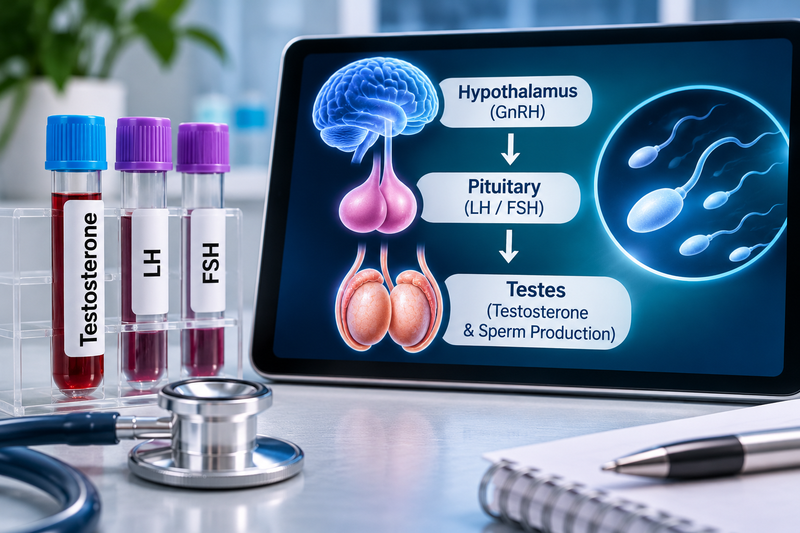
The hypothalamic-pituitary-gonadal (HPG) axis coordinates reproductive hormone production.
The hypothalamus releases gonadotropin-releasing hormone (GnRH). This signals the pituitary gland to produce LH and FSH.
LH stimulates natural testosterone production within the testes. FSH supports Sertoli cell activity and sperm development.
When external testosterone enters the body, it can influence negative feedback mechanisms. The hypothalamus and pituitary may reduce their hormonal signaling in response.
Consequently, LH and FSH concentrations can decrease. Intratesticular testosterone may also decline, even when circulating testosterone remains elevated.
Changes in Spermatogenesis
Reduced gonadotropin signaling can influence sperm production. Depending on the degree of hormonal suppression, sperm concentration may decrease substantially.
Some individuals develop oligozoospermia, meaning a lower-than-expected sperm concentration. Others may experience azoospermia, which means sperm are absent from the ejaculate.
These responses vary according to individual physiology, exposure duration, and other clinical factors. They are important considerations when evaluating testosterone therapy and fertility.
The 2024 AUA/ASRM male infertility guideline explains the relationship between external testosterone, gonadotropin suppression, and spermatogenesis.
Testosterone Replacement Therapy and Family Planning
Testosterone replacement therapy (TRT) is used in appropriately diagnosed men with hypogonadism. Its clinical objective is to address symptoms associated with confirmed testosterone deficiency.
However, fertility planning introduces additional considerations.
The Endocrine Society recommends against initiating testosterone therapy in men planning fertility in the near term. The AUA/ASRM guideline also advises clinicians against prescribing exogenous testosterone to men interested in current or future fertility.
This distinction is important when discussing testosterone treatment with men who plan to have children.
A healthcare professional can evaluate the underlying hormonal condition and discuss approaches that consider both testosterone levels and reproductive objectives.
For further information about testosterone formulations, see our article on Testosterone Propionate vs Enanthate: Ester Differences and Clinical Context.
Can Sperm Production Recover After Testosterone Therapy?
Research indicates that sperm production can recover following the discontinuation of external testosterone. However, the recovery process varies between individuals.
The AUA/ASRM guideline reports that sperm may return to the ejaculate in most previously azoospermic men after testosterone therapy ends. Recovery can take several months and, in some cases, years.
Factors influencing recovery include:
- Duration of previous testosterone exposure.
- Degree of hormonal suppression.
- Individual reproductive health.
- Baseline testicular function.
- Other underlying hormonal conditions.
Recovery of circulating testosterone does not necessarily mean that sperm production has fully recovered.
A 2025 review in Nature Reviews Urology examines testosterone replacement therapy and spermatogenesis in reproductive-age men. It discusses recovery patterns and current approaches to maintaining reproductive function.
How Is Male Fertility Evaluated?
A proper assessment considers reproductive history, hormonal activity, and semen characteristics. No single testosterone measurement can independently establish male fertility.
Semen Analysis
A semen analysis is a central component of male fertility evaluation. It examines several characteristics of the ejaculate and sperm cells.
Common parameters include:
- Sperm concentration.
- Total sperm count.
- Sperm motility.
- Sperm morphology.
- Semen volume.
These measurements help clinicians assess reproductive function. Results should be interpreted alongside medical history and other relevant findings.
Hormonal Testing
Hormonal evaluation can provide information about the factors regulating sperm production.
Relevant measurements may include:
- Total testosterone: Provides information about circulating testosterone concentrations.
- Luteinizing hormone (LH): Helps assess stimulation of testosterone production by Leydig cells.
- Follicle-stimulating hormone (FSH): Provides information about hormonal regulation associated with sperm production.
- Additional testing, including prolactin or estradiol, may be considered according to individual findings.
Clinical Approaches for Men With Low Testosterone and Fertility Goals
Men with low testosterone and reproductive goals may require an individualized hormonal assessment.
Treatment selection depends on the underlying cause, hormonal profile, reproductive history, and available clinical evidence.
1. Gonadotropin-Based Approaches
Human chorionic gonadotropin (hCG) acts similarly to LH. It stimulates Leydig cells and supports natural testosterone production within the testes.
FSH-based treatment may also be considered in selected conditions involving impaired gonadotropin signaling.
These treatments have established roles in appropriately diagnosed reproductive endocrine conditions. Their application depends on the underlying diagnosis.
2. Selective Estrogen Receptor Modulators
SERMs, including clomiphene, influence estrogen feedback within the hypothalamus and pituitary gland.
This mechanism can increase LH and FSH signaling, supporting endogenous testosterone production and reproductive hormone activity in selected men.
Read our article on Clomiphene: Medical Uses, Mechanism, and Side Effects for further information about its pharmacological characteristics.
3. Aromatase Inhibitors
Aromatase inhibitors reduce the conversion of testosterone into estradiol. In selected clinical situations, this can influence the hormonal feedback system and endogenous testosterone production.
The AUA/ASRM guideline recognizes aromatase inhibitors, hCG, and SERMs as possible approaches for selected infertile men with low serum testosterone. This recommendation carries a conditional evidence grade.
These medications are not interchangeable, and their suitability depends on the underlying hormonal condition. Some applications in men are off-label and require specialist assessment.
Testosterone Levels Are Not the Only Measure of Male Fertility
Testosterone contributes to reproductive function, but fertility involves several interconnected processes.
A man may have circulating testosterone within the reference range and still present with altered semen parameters. Conversely, testosterone deficiency does not automatically establish infertility.
Reproductive health also depends on sperm production, sperm quality, testicular function, hormonal signaling, and the reproductive health of both partners.
This explains why testosterone and male fertility should be evaluated through complementary clinical measurements.
A comprehensive approach provides a clearer understanding than relying exclusively on serum testosterone results.
Conclusion: Understanding Testosterone and Male Fertility
Testosterone plays an essential role in male reproductive physiology and spermatogenesis. Its relationship with fertility depends on coordinated hormonal activity involving LH, FSH, and intratesticular testosterone.
External testosterone introduces a different hormonal dynamic through feedback regulation. Understanding this distinction is particularly important for men considering treatment while planning a family.
Current clinical evidence supports individualized fertility evaluation and treatment planning. Semen analysis, hormone measurements, and reproductive history help healthcare professionals understand each individual’s circumstances.
At Vpharma Lab, we aim to explain testosterone through accurate pharmacological information and current scientific evidence. Explore the Vpharma Lab Blog for additional educational articles about testosterone and hormonal health.
Frequently Asked Questions About Testosterone and Male Fertility
1. Does Testosterone Affect Male Fertility?
Yes. Testosterone supports sperm production and reproductive function. Its effects depend on whether it is produced naturally or introduced through external formulations.
2. Does Testosterone Therapy Affect Sperm Production?
External testosterone can suppress LH and FSH signaling. This may reduce intratesticular testosterone and influence sperm production.
3. What Is Intratesticular Testosterone?
It is testosterone present within testicular tissue. Its concentration is considerably higher than circulating testosterone and supports spermatogenesis.
4. Can Testosterone Levels Be Normal While Sperm Count Is Low?
Yes. Serum testosterone and sperm production measure different aspects of reproductive physiology. A semen analysis provides direct information about sperm parameters.
5. What Is the Difference Between Oligozoospermia and Azoospermia?
Oligozoospermia refers to a lower sperm concentration. Azoospermia means no sperm are detected in the ejaculate following appropriate laboratory assessment.
6. Can Sperm Production Recover After Testosterone Therapy?
Recovery occurs in most men following cessation of exogenous testosterone, although the timeframe varies. It can take months and sometimes years.
7. Which Hormones Are Important for Male Fertility?
Testosterone, LH, and FSH are central to reproductive regulation. Prolactin and estradiol may also be evaluated in selected clinical situations.
8. What Is the Role of Clomiphene in Male Reproductive Health?
Clomiphene modulates estrogen feedback at the hypothalamus and pituitary. In selected men, this can influence LH, FSH, and endogenous testosterone production.
9. Can Testosterone Treatment Be Considered When Planning a Family?
Men seeking current or future fertility require specialist assessment before considering external testosterone. Clinical guidelines advise against prescribing exogenous testosterone to men interested in preserving current or future fertility.
10. Which Tests Help Evaluate Male Fertility?
Semen analysis is a central test. Hormonal measurements, including testosterone, LH, and FSH, may provide additional information according to the individual’s medical history.
References and Further Reading
- American Urological Association / American Society for Reproductive Medicine. Diagnosis and Treatment of Infertility in Men: 2024 Amended Guideline.
- Endocrine Society. Testosterone Therapy for Hypogonadism: Clinical Practice Guideline.
- Nature Reviews Urology (2025). Testosterone Replacement Therapy and Spermatogenesis in Reproductive Age Men.
- American Society for Reproductive Medicine. Diagnosis and Treatment of Infertility in Men: AUA/ASRM Guideline Part II.


