

Testosterone Propionate vs Enanthate: Ester Differences and Clinical Context
Testosterone propionate vs enanthate is a common comparison when examining injectable testosterone formulations. Both contain the same active hormone, but their ester structures influence how testosterone is released into circulation.
These differences affect pharmacokinetics, including the duration of action and changes in testosterone concentrations over time. Understanding them also requires considering medical indications, individual response, and clinical monitoring.
At Vpharma Lab, we explain these compounds through their pharmaceutical characteristics and medical context. This guide compares testosterone propionate and testosterone enanthate, focusing on their ester structures, release profiles, and clinically relevant differences.
What Are Testosterone Propionate and Enanthate?
Testosterone is a hormone involved in reproductive function, bone health, muscle maintenance, and the development of male secondary sexual characteristics.
Testosterone propionate and testosterone enanthate are esterified forms of the same hormone. An ester is attached to the testosterone molecule, changing its pharmaceutical properties and influencing its release following injection.
After administration, the ester is gradually removed through enzymatic hydrolysis. This process releases testosterone, which interacts with androgen receptors throughout the body.
The principal difference between these formulations is their release profile, not the identity of the active hormone.
Our Testosterone Propionate guide explains the shorter ester’s general pharmacology in more detail.
Testosterone Propionate vs Enanthate: Key Differences
| Characteristic | Testosterone Propionate | Testosterone Enanthate |
| Ester structure | Shorter propionate chain | Longer enanthate chain |
| Release profile | Relatively shorter acting | More prolonged release |
| Active hormone released | Testosterone | Testosterone |
| Pharmacokinetic pattern | Generally shorter exposure profile | Generally more sustained exposure |
| Medical context | Formulation availability varies by country | Used in prescribed testosterone replacement therapy |
| Monitoring considerations | Depends on the clinical formulation | Depends on the clinical formulation |
These differences describe general pharmacological characteristics. Actual concentration patterns depend on the specific formulation, administration route, and individual physiology.
How Do the Ester Structures Differ?
1. Testosterone Propionate
Testosterone propionate contains a relatively short ester chain. This structure contributes to its shorter release profile when administered in an appropriate injectable formulation.
After injection into an oil-based depot, the compound gradually enters circulation. Enzymatic hydrolysis subsequently releases the active testosterone hormone.
Its shorter ester chain influences how the formulation behaves within the body. However, it does not create a fundamentally different androgenic mechanism.
2. Testosterone Enanthate
Testosterone enanthate contains a longer ester chain than testosterone propionate. This structure generally supports slower release from an oil-based injection depot.
Once the ester is removed, the released hormone is testosterone. Its biological effects therefore involve the same principal androgen receptor pathways.
The longer ester affects how the hormone enters circulation and how concentrations change over time. This characteristic helps explain why enanthate generally has a more prolonged release profile.
Our Testosterone Enanthate guide provides further information about this formulation’s characteristics.
Half-Life and Duration of Action
Testosterone propionate has a shorter release profile than testosterone enanthate. This difference influences their pharmacokinetic patterns and the way healthcare professionals evaluate treatment schedules.
Half-life describes how quickly a measured drug concentration decreases. With injectable testosterone esters, however, absorption from the injection depot also contributes to the observed concentration pattern.
For this reason, half-life figures can vary according to the formulation and measurement method. A published value should not be treated as a precise prediction for every individual.
Testosterone enanthate generally provides a more prolonged release than propionate. Its prescribing information describes gradual absorption from the oil phase following intramuscular administration.
The precise duration of action and clinically appropriate administration schedule depend on the particular product and treatment plan. Release duration should not be confused with the duration of every physiological effect.
Medical Context of Testosterone Formulations
Testosterone replacement therapy is used for appropriately diagnosed cases of hypogonadism. This condition involves insufficient testosterone production associated with an underlying clinical disorder.
The diagnosis should not rely on symptoms alone. The Endocrine Society recommends evaluating compatible symptoms alongside consistently low testosterone concentrations, confirmed with repeat morning testing.
The clinical role of a formulation depends on its approved indications and availability. Testosterone enanthate is an established injectable option in testosterone replacement therapy. The availability and clinical role of propionate formulations vary between countries.
These distinctions matter because different ester formulations are not automatically interchangeable in every clinical situation. Healthcare professionals consider the product, treatment response, relevant medical history, and laboratory findings.
Physiological Effects and Safety Considerations
Because both formulations release testosterone, they share many potential physiological effects. Their different release profiles do not eliminate the adverse effects associated with testosterone exposure.
Possible effects include acne, changes in skin oiliness, fluid retention, and increased red blood cell production. Testosterone therapy may also suppress the body’s own hormonal signaling and sperm production.
Other considerations include changes in blood pressure, lipid profile, mood, and prostate-related clinical assessment. The relevance of each factor varies according to individual health and the treatment context.
Testosterone treatment can impair fertility by reducing sperm production. People planning a pregnancy should discuss this consideration with a qualified healthcare professional before treatment.
These effects are not inevitable, and their probability varies between individuals. The aim of clinical assessment is to identify relevant risks and evaluate treatment response appropriately.
What Does Clinical Monitoring Involve?
Monitoring depends on the indication, the specific formulation, and the patient’s medical circumstances.
Before testosterone replacement begins, clinicians generally confirm the diagnosis and assess relevant health factors. This may include hormone measurements, a review of medical history, and additional testing based on individual needs.
Follow-up may assess testosterone concentrations, symptom response, adverse effects, and treatment-related changes in blood parameters. Prostate assessment may also be appropriate according to age, risk factors, and clinical guidance.
The timing and selection of tests are individualized. Laboratory results and symptoms should be interpreted together rather than relying on a single measurement.
These principles apply to testosterone therapy regardless of whether propionate or enanthate is being considered. The exact monitoring plan should be determined by the treating clinician.
Testosterone Propionate vs Enanthate: Which Is Different Clinically?
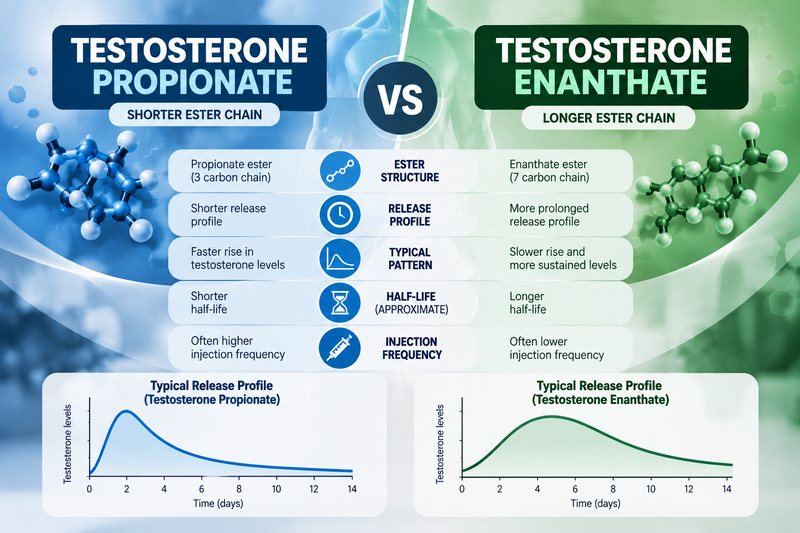
The main distinction is pharmacokinetic. Propionate generally has a shorter release profile, while enanthate generally provides more prolonged release.
Neither ester releases a fundamentally different form of testosterone. Their shared active hormone explains why many physiological effects and safety considerations overlap.
The most relevant formulation depends on the medical indication, approved product, individual circumstances, and clinical evaluation. Duration alone does not determine whether a preparation is appropriate.
Frequently Asked Questions About Testosterone Propionate vs Enanthate
1. What is the main difference between testosterone propionate and enanthate?
Their ester structures differ, affecting the release profile. Both ultimately release the same active hormone: testosterone.
2. Which ester has a shorter release profile?
Testosterone propionate generally has a shorter release profile than testosterone enanthate.
3. Does testosterone enanthate release a different hormone?
No. Both formulations release testosterone after enzymatic removal of their respective ester groups.
4. Do the esters have different biological mechanisms?
Their principal androgenic mechanism is the same. Differences mainly involve absorption and release characteristics.
5. What does testosterone ester half-life mean?
It describes a pharmacokinetic characteristic, but injection-depot absorption also influences the measured concentration pattern.
6. Are the formulations medically interchangeable?
Not automatically. Suitability depends on the specific product, clinical indication, and individual circumstances.
7. Can both formulations affect fertility?
Yes. Exogenous testosterone can suppress sperm production and affect fertility.
8. Why is testosterone monitoring important?
Monitoring helps evaluate hormone levels, treatment response, and potential adverse effects.
9. Does a longer release profile guarantee better results?
No. Duration is only one characteristic and does not determine an individual’s clinical response.
10. Where can readers find more information?
Consult the relevant prescribing information, clinical guidance, and the Vpharma Lab Blog for additional educational articles.
Conclusion: Understanding Testosterone Ester Differences
Testosterone propionate and testosterone enanthate release the same active hormone but have different pharmacokinetic profiles. Propionate generally has a shorter release profile, while enanthate supports more prolonged release.
Their clinical relevance depends on the formulation, medical indication, and individual circumstances. Understanding ester structure, duration, and monitoring provides a clearer basis for comparing these preparations.
At Vpharma Lab, our goal is to explain pharmaceutical characteristics accurately and in context. For more educational content, visit the Vpharma Lab Blog.


